Scroll Thru to read all the fascinating
Football History articles
Volume I-101-112 CLASSIC FOOTBALL HISTORY
LOUIS F. BLAKLEY PhD
classicollectables@sbcglobal.net
CLASSIC FOOTBALL HISTORY
Volume II-112
BRONKO NAGURSKI
THE BRONKS HITTING STYLE
In 1930 Bronko Nagurski known as “The Bronk”
had a reputation as the toughest pro football player in the NFL.
His style was described as smashing, driving and forever fighting.
On September 28th 1930, the second game of the season between the
Chicago Bears and the Green Bay Packers, the Bronk hurt two Packer
players. The first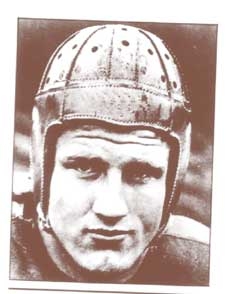 player was Hurdis McCrary, FB by ramming his knee up into his chin.
The second was Cully Lidberg RB who was carried off the field with
broken bones after being hit by the bone crushing Bronk. Lidberg
was good at hitting and tackling himself but ran into trouble against
Nagurski. Lidberg made the mistake of getting into a head on collision
with Nagurski at the line of scrimmage. “The Bronk”
was booed for this hit, when he saw the Packer lying there not moving
it shook him up. Lidberg was in great pain and could be heard moaning
as
player was Hurdis McCrary, FB by ramming his knee up into his chin.
The second was Cully Lidberg RB who was carried off the field with
broken bones after being hit by the bone crushing Bronk. Lidberg
was good at hitting and tackling himself but ran into trouble against
Nagurski. Lidberg made the mistake of getting into a head on collision
with Nagurski at the line of scrimmage. “The Bronk”
was booed for this hit, when he saw the Packer lying there not moving
it shook him up. Lidberg was in great pain and could be heard moaning
as 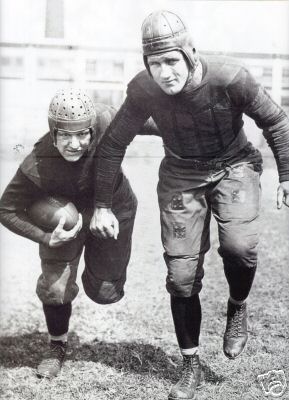 he
was taken away on a stretcher from City Stadium. As Lidberg was
being carried from the field, the Bronk told the Bears Quarterback
Carl Brumbaugh “I’m never going to hit a man like that
again. Brummy I don’t want them to think I’m a dirty
player no way.” George Trafton the Bears center heard what
the Bronk said “Look… everyone in the league is gunning
for your…besides, with me around, nobody is ever gonna call
you a dirty player.” Bronko Nagurski had developed his style
of hitting and tackling as a linebacker at the University of Minnesota.
He would fold both of his arms across his chest and lean forward
at a forty-five degree angle, driving his right shoulder into his
opponent’s sternum. The player would go down and stay down
most of the time. Some players were left breathless, others unconscious. he
was taken away on a stretcher from City Stadium. As Lidberg was
being carried from the field, the Bronk told the Bears Quarterback
Carl Brumbaugh “I’m never going to hit a man like that
again. Brummy I don’t want them to think I’m a dirty
player no way.” George Trafton the Bears center heard what
the Bronk said “Look… everyone in the league is gunning
for your…besides, with me around, nobody is ever gonna call
you a dirty player.” Bronko Nagurski had developed his style
of hitting and tackling as a linebacker at the University of Minnesota.
He would fold both of his arms across his chest and lean forward
at a forty-five degree angle, driving his right shoulder into his
opponent’s sternum. The player would go down and stay down
most of the time. Some players were left breathless, others unconscious.
On November 9th 1930 in Chicago, the Bears played the Green Bay
Packers. During the game the Packers Cal Hubbard said to Red Grange
the running back of the Bears “Hey, Ghost, let me through
this time. I promise I wont block the punt. I just want a shot at
that Nagurski; I want to see if the boys as tough as everybody says.”
Red Grange, The Galloping Ghost, had seen enough of Nagurski’s
playing style to know that he was the toughest pro football player
of all time and it was not just talk.
Grange agreed because he knew what would happen, this would be
a lesson that Hubbard would never forget. Cal Hubbard came through
the line full blast and came right at Nagurski and the Chicago Bronk
gave him a stiff right arm to the Packer’s jaw there was a
loud crack, the crowd could hear it in the stands.
Cal Hubbard was on the ground, once he got to his feet he was stumbling,
groggy and having trouble focusing. After his lesson with the Bronk
Hubbard came up to Red Grange slurring his words and said “
Thanks, Ghost, my old pal, please make sure that never happens again.”
Early in the third quarter Bronko Nagurski ripped through three
Packer tacklers, Verne Lewellen, HB/FB and Cal Hubbard, T/G and
one other Packer. He ran fifty-seven yards before these three Green
Bay Packers caught up with Nagurski and brought him down at the
two-yard line. Carl Brumbaugh the Bears QB (who was not wearing
a leather football helmet) had tricked the Packers by using the
Bronk as a decoy. Brumbaugh had pulled the ball out from Nagurski
arm and pitched it to Bears halfback Laurie Walquist who scored
the touchdown for six points, but the extra point was missed.
In the final two minutes of the game Nagurski carried the ball
eight times to the two-yard line. Then Carl Brumbaugh handed the
Bronk the ball, he blasted through two Packers for a touchdown.
However he had been running with his head down and hit the outfield
wall head on with his leather helmet and bent his neck.
The crowd saw this and there was a loud groan all across the stadium.
Nagurski was shook up from the crash; his legs felt like rubber
as he staggered to the Bears bench. When he managed to get to the
sidelines George Trafton ask “you all right Bronk?”
“Yep Traf, but that last… hit me pretty hard”
said the Bronk, Trafton laughed… Bronk, that wasn’t
no player you just cracked a brick in that… wall.” Twice
in his career he had run head first into the outfield wall at Wrigley
field. Two different times he was running with such fury through
the south end of the end zone that he ran down into the dugout steps.
The Packers went on to win the game 13-12. Al Capone, the Chicago
mobster who was at the game said “Greatest…performance
I’ve ever seen.”
During the 1931 season the Bronk had knocked a police officer off
his horse. He had run into a Police car on the sideline and tore
off the front fender. Bronko Nagurski in his third season (1932)
as a pro football player was the most frightening man in the NFL.
He had great strength and a rage that drove him. The Bronk knocking
out football players was a part of his playing style besides running
into brick walls; he even knocked down a horse during a game. These
are true stories not made up; this was the kind physical power this
man had. When he hit a player in the head they were on the way to
the hospital. The most terrible sight for opposing players was the
Bronk with the football. He was a fearsome fullback.
Nagurski style of running at fullback was to run straight up with
the ball in his stomach, this way he could survey the football field,
next he would dip his left shoulder this was a sign of trouble for
opposing players, it was normal to see him run over two defenders.
Then once past the line of scrimmage he would go low. It was at
this point he would break lose like a ragging “Bronk”
storming out of the gate of a chute in a rodeo. He also had awesome
speed for a big man and would simply run over football players,
no one got in his way; anyone who did paid a high price with his
health.
The Bronk was once asked how fast are you? He said “fast
enough.” Players from other teams had a hard time bringing
down Nagurski in the open field. Most of the time it took three
or four players to ride him and bring him down. He would buck players
off like a wild Bronk, this is how he earned his nickname. Red Grange
knew what it was like trying to tackle the Bronk he said, “when
the Bronk hits you, its like getting an electric shock, better not
hit above the ankles. He’ll kill you.”
On September 25th 1932, the first game between the Chicago Bears
and the Green Bay Packers, in the second week of the season during
the third quarter, the Bronk who did not talk much in the huddle
ask Carl Brumbaugh the Bears QB “Give me the…ball”
then he told George Trafton “Don’t block number thirty-one
(fullback Clarke Hinkle, who was the Nagurski of the Packers the
most underrated pro football player of his time). I want a piece
of his…Nagurski took his right shoulder and aimed at Hinkle
who was waiting for him in the linebacker position, when all on
a sudden the Bronk smashed into him, his knee hit the Packer in
the chin then he ran across his chest with his cleats. All Hinkle
remembered was being brutally hit. It took six Packers to bring
down the Bronk 40 yards later.
Clarke Hinkle woke up on the sideline when a trainer had broken
two capsules of smelling salts in his nose (the smell was like an
acid odor of ammonia) the smell woke him up. Hinkle coughed in pain
his nose had been shattered, and his chin had a gash that needed
seven stitches. Clarke Hinkle thought you have to be alot tougher
than this if you’re going to play this game. The game ended
in a scoreless tie. Nagurski and Hinkle came from the same mold
they were both the strongest and toughest men in pro football. Clarke
Hinkle was the only player at the time that was an even match for
the Bronk.
On September 24th 1933 at East Stadium in Green Bay, the first
game between the Bears and the Packers, Clarke Hinkle had a chance
to pay the Bronk back. In the first quarter on third down Hinkle
had a choice to kick or run, he saw a weak spot in the Bears defense
and ran. He saw Nagurski coming right at him it looked like he would
be knocked out of bounds short of the first down, but Hinkle went
after the Bronk instead and drove his left shoulder into his jaw.
The Bronk went down unconscious, the Bear trainers rushed onto
the field and broke ammonia capsules under his nose, he woke up
and jerked then he yelled, “Where is that… Hinkle.”
His nose was pushed horribly to the left side of his face; his jersey
was covered in blood. Nagurski also had sharp pain in his right
hip. Hurting and in pain he was helped to the Bears bench where
he stayed the rest of the game. The Chicago Bears won 14-7.
Most players feared Nagurski but not Clarke Hinkle, the fullback
of the Green Bay Packers, even though Nagurski had hurt him in the
past. He was a hard-hitting pro himself. The Bronk had no empathy
for Hinkle whom he felt was a dirty player. In time this would change,
both players developed great respect for one another. Further more,
Nagurski did not like the fact that Hinkle was getting a reputation
like himself. The Bronk did not like sharing the stage with another
player.
On November 12th 1933 at the Baker Bowl in Philadelphia (The formal
name was National League Park the name painted on the Stadium) the
Chicago Bears played the Philadelphia Eagles, in the first quarter
John “Bull” Lipski a rookie Eagle linebacker made the
mistake of coming straight at Nagurski, it was the Bull against
the Bronk. Nagurski dropped his left shoulder and rammed into the
Bulls jaw and as he went down and he slammed his head on the ground
knocking him out. The Eagle trainers ran on to the field and snapped
ammonia capsules under the Bulls nose and started helping him off
the field.
The next play Carl Brumbaugh Quarterback of the Bears handed the
ball off to the Bronk who thought he saw three defenders in his
way; he did not realize that they were the two Eagle trainers helping
the Bull off of the field. The Bronk lowered his right shoulder
and blasted into all three of them, they all went flying in different
directions. Lipski hit his head on the ground again and was knocked
out for the second time. The play ended after thirty yards when
the Bronk was knocked out of bounds, when he got up he saw the two
Eagle trainers laying on the field not moving and Lipski “The
Bull” knocked out. Nagurski realized who he had hit and walked
over to the Eagle sideline and took off his leather helmet and said
“I’am sorry you fellas, really should get out of my
way while I’m running,” he was a monster on offense
at fullback.
Just the mention of the name Bronco Nagurski brought dread to the
players that had to play against him. They disliked having to deal
with “The Bronk” the strongest, toughest man in pro
football. The other scariest sight for other teams was the Bronk
at linebacker, digging in his cleats, his teeth clenched; his steely
eyes staring ahead with that look in his eyes like, you have had
it now. Nagurski on defense ran down his victims and would drive
their heads into the ground. He was an overpowering, strong ferocious
linebacker, that sledge hammered his victims. It was very rare for
other teams to run the ball on his side of the field. He could run
after ball carriers from across the football field and tackle them;
he was lighting fast. In the 1930s the Bears were playing knockout
defense and the Bronk led the way.
No football player was more feared or respected than Bronko Nagurski.
It was not uncommon for the Bronk to feel bad about sending players
to the hospital; he would be stressed for days over it. He had hurt
over a dozen football players. In 1930, his rookie year, he had
knocked out many men and made an attempt to change his tackling
style, for a while he stopped hitting in the head. Bronko Nagurski
had intimidated many pro football players in the NFL, the press
said, not in the history of football had such a powerful man laced
up cleats.
According to George Halas he could never remember the Bronk hitting
any harder than on October 20th 1935 when the Chicago Bears hosted
the Brooklyn Dodgers football team at Wrigley Field in Chicago.
The Dodgers trainers were wore out from carrying so many players
off the field. The Bears went on to win the game 24-14. George Halas
always insisted that Bronko Nagurski was the best player of all.
On September 20th 1936 on opening day the Bears and the Packers
met at East Stadium in Green Bay to play their first game of the
season the Bears won 30-3. This score was due to the hard hitting
and running of Bronko Nagurski who was a powerhouse player. On November
1st 1936 in the second meeting between the Bears and the Packers
at Wrigley Field in the seventh game of the year Clarke Hinkle had
a great day, the Packers won the game 21-10.
After the game the Bronk walked over to Hinkle and put out his
hand, and the two shook hands. These two Future Hall of Famers had
not said one kind word to each other in four years, but on this
day Nagurski said to Clarke Hinkle “some of the best running
I’ve seen you’re a hard fella to stop…”
Hinkle said… Bronk you’re the toughest… I’ve
ever seen. At least you didn’t knock me out this time.”
On Sunday December 12th 1937, during the Championship game between
the Chicago bears and the Washington Redskins, late in the third
quarter, coach Hunk Anderson sent in Bronco Nagurski. On third down
at the Redskin forty yard line Sid Luckman the bears Quarterback
handed off to the Bronk, Luckman said it felt like his arm had been
ripped off as the Bronk took the ball. Nagurski blasted ahead and
plowed over Sammy Baugh who was knocked senseless, he was so groggy
that he could hardly get to his feet. Sid Luckman helped Baugh to
get up. Luckman said to Baugh “That Nagurski is the toughest
son-of-a gun I’ve ever seen.” Baugh responded …
“you should’ve seen that sumbuck in his prime. I ain’t
never seen a player that big, that strong, and that fast. He’s
the best there ever was.” The Redskins went on to win the
World Title 28-21.
Bronko Nagurski, the big Bronk wore a size 8 leather helmet and
his ring size was19½ inches. The Bronk retired after the1937
Championship, but in 1943 came out of retirement and reported to
the Chicago Bears training camp because of the man shortage due
to World War II. There was heavy hitting in camp and Nagurski had
hurt several of his Bear teammates. There were broken noses and
even a fractured clavicle. It was the Bronk who had done most of
the damage; he still had great strength even though he had been
in retirement for six years.
In training camp George Musso was to lineup against the old Bronk,
the fact that the Bronk was older did not seem to matter to Musso.
He told coach Hunk Anderson to get someone else to block Nagurski.
The co-head coach pushed Musso aside, and to prove that he was still
as tuff as any of the players, Anderson got down in a three point
stance to take on the Bronk. Nagurski blasted forward and slammed
into his coach using his right forearm, which was still very powerful,
and hit him right in the breastbone and knocked him back on his
head, which knocked him out. Smelling salts were used, when Anderson
woke up he was yelling and upset with Nagurski for hitting him so
hard. Most players not hit their coach but the Bronk was different
no one got in his way. In 1943 he could no longer run as a fullback
like in his glory days from 1930-1937, instead he would play on
the line offensive and defense for most of the season, but he could
still hit, block and tackle.
From the first time that Sid Luckman, the Quarterback of the Chicago
Bears, saw Nagurski he respected him greatly. During the 1943 season
during a game against the Detroit Lions Sid Luckman noticed the
fear the Bronk had struck in the lion players. In the days when
brute force was a normal part of pro football and hitting was truly
smash mouth, when only the meanest toughest men played the game
this was remarkable for players to be scared of one man. However
this was the kind of professional football player he was. It may
never be known how many knock outs and broken bones the Bronk inflicted
on players what is known he was not only the toughest but one of
the most talented pro football players that ever played the game
of Professional Football.
The Chicago Bear’s beat the Washington Redskins 41-21, in
the 1943 Championship Game on Sunday December 26th. After the game
both Bronko Nagurski and George Musso with tears in his eyes walked
together on the way to catch a cab that would take the Bronk to
Illinois Central station for home. Musso said, “You’re
the greatest player who ever lived, and you’re the greatest
friend I’ve ever had.” Nagurski said “Don’t
cry, big man, just keep knocking them down.” Musso knew that
his friend was retired for good this time.
Bronko Nagurski played in five world Championships 1932, 1933,
1934, 1937 and 1943. Losing twice in 1934 to the New York Giants
in the great sneakers game and 1937 to Sammy Baugh and the Washington
Redskins. The Bronk had played on three World Championships teams
1932, 1933, and 1943. His talent was one of the main reasons for
the Chicago Bears success in the 1930s. George Halas always said
that this man was the best of all time. This was a powerful statement
coming from the Father of Pro Football.
Volume II-111
LOUIS F. BLAKLEY PhD
Classicollectables@sbcglobal.net
The 1938 CHAMPIONSHIP
1938 had been a successful year for both the New York Giants who
won the Eastern Division with an 8-2-1 record and the Green Bay
Packers who clinched the Western Division title with a record of
8-3-0. Now the NFL’s two best teams were headed for the final
grand finally the World Championship.
The Green Bay Packers arrived in New York City and checked into
the Victoria Hotel for their second championship game. Their first
was played on Sun. December 13, 1936 at the Polo Grounds in New
York City; the Packers beat the Boston Redskins 21-6. Within hours
the Green Bay Packers held their first practice session in Central
Park. Don Hutson who had injured his knee on Sun. November 13, 1938
in Detroit against the Lions did not practice, the Packers did win
the game 28-7, however their star player was hurt. Head Coach Curly
Lambeau had Hutson spend time with the team to keep his knee injury
a secret from the New York Giants.
This was the Giants fourth championship game. The New York Giants
played the Chicago Bears in the first official NFL championship
on Sun. December 17, 1933 the Bears won 23-21. The Giants played
the Chicago Bears the following year on Sun. December 9, 1934 in
the great sneakers game; the Giants beat the Bears 30-13. And New
York met the Detroit Lions Sun. December 15, 1935 and was beaten
for the second time 26-7. Now these two great teams were in the
sixth NFL Championship Game.
The 1938 Championship game was played on Sun. December 11th at
the Polo Grounds. This was the second time Green Bay had played
in world title game in New York in two years. The Packers were favored
to win in what turned out to be a hard-fought nasty slugfest. The
Green Bay Packers wore their Notre Dame Colors; dark blue jerseys
with yellow colored shoulders and numbers and their famous yellow
leather football helmets and tan colored pants. Curly Lambeau wore
a tweed coat and a dark fedora. The New York Giants were dressed
in blue jerseys with white numbers, blue leather helmets with a
red color wing on the front and red straps, and tan pants. These
were great looking uniforms and colorful. The colored leather football
helmets were a true classic for both teams.
The New York Giants were not a very impressive group as they lined
up in the locker room before kick off. Beat up, hurt and limping
these Giants were not in shape for a championship game so they were
being wrapped in rolls of tape by their team physician Dr. Francis
Sweeny. Among the Giant wounded were Mel Hein C, Tuffy Leemans FB
both two future hall of famers, Ed Danowski TB, Jim Lee Howell RE,
(Howell, the Giants future head coach replaced Steve Owen in 1954.
He quickly hired Vince Lombardi as offensive coordinator and converted
Tom Landry from a defensive player to defensive coordinator both
went on to be great coaches. Howell served as head coach for seven
seasons 1954-1960). The other Giant wounded were Johnny Dell Isola
the old pro guard, Ward Cuff K/HB and Lee Shaffer RB one of the
Giants best ball carriers, all these warriors were led by their
head coach Steve Owen who would himself be in the hall of fame.
The Giants all looked terrible before kick off and looked even worse
once the game was under way.
The Packers were a big strong team much healthier than their Giant
opponents led by Arnie Herber QB, head coach Curly Lambeau, Clarke
Hinkle FB, and their great injured left end Don Hutson. All future
hall of famers and halfback Ceil Isbell who was a great quarterback.
Green Bay was determined to beat their Eastern opponents for the
world championship but with Hutson hurt this would be difficult;
he was their go to guy.
In the first quarter two Packer punts were blocked by Giants Jim
Lee Howell and Jim Poole LE that turned into scores. The New York
Giants turned one of the blocked kicks into a thirteen-yard field
goal by Ward Cuff; the score was 3-0. Then Tuffy Leemans the Giants
fullback ran for a six-yard touchdown for six points, but Johnny
Gildea missed the extra point, the score stood at 9-0.
At the start of the second quarter Arnie Herber the Packers quarterback
threw a forty-yard pass to Carl Mulleneaux, who ran for a touchdown
for six points then Tiny Engebretsen kicked the extra point the
score was now 9-7 the Giants still in the lead. Coach Lambeau was
sending in Don Hutson to the game as a decoy to mislead the Giants
from time to time but the Giants saw Hutson limping and paid no
attention to the great Packer end. Hutson had reinjured his knee
in the second period he did not return until late in the fourth
quarter. With the football back in the Giants hands Ed Danowski
threw a twenty-yard touchdown pass to Charles Barnard the New York
end for another six points. Ward Cuff kicked the extra point the
score was 16-7. It was now the Packers turn to score when Clarke
Hinkle the Packers fullback ran for a one-yard touchdown, again
Tiny Engebretsen kicked the extra point the score was the Packers
14 and the Giants 16 at halftime.
In the first half Green Bay had given the Giants a brutal physical
beating. Center Mel Hein had to leave the field from the savage
Packer hitting and Johnny Dell Isola as well. The Packers came right
at Hein with ruthless force; this was the first time that the great
center had to be carried off the football field. Mel Hein was an
all-pro center and was the MVP of 1938. The New York Giants still
managed to go to the locker room at halftime with a 16-14 lead.
Coach Steve Owen did his best to pull together his beat up wounded
football team for the second half.
With Hutson’s injury and unable to play and the Giants ahead
even only by two points, at the start of halftime Curly Lambeau
had on his mind what he going to say to his players. On his way
to the locker room he was not paying any attention to where he was
going and took a wrong turn and went through a door that he thought
was the dressing room and instead found himself locked outside the
stadium, on a New York City street. He pounded on the door but no
one answered, so Lambeau ran to the nearest gate, but the security
guard would not let him in. Then he ran to the next gate but nothing
the coach could say would get him past the second guard who refused
to let him into the stadium as well. In the mean time back in the
locker room the Packer players were wondering what had happened
to their coach. With the absence of coach Lambeau they could not
agree on a new game plan. Mean while still outside the stadium coach
Lambeau was running out of time so he charged the main gate but
was stopped for the third time. Lambeau was so upset by now that
he began yelling loud enough that he drew a crowd that included
some reporter’s that recognized the Packer coach and convinced
the guards of who he was. By the time he reached the locker room
half time was over and he missed the chance to address his players.
Shortly after intermission Green Bay’s Tiny Engebretsen kicked
a fifteen-yard field goal for 3 points. The very thing that Giant
coach Steve Owen was concerned about at halftime. The score was
now 17-16. For the first time Green Bay was ahead, but only by one
point. In the second half the Giants played magnificently in the
face of all their injuries, but then all of a sudden things started
to turn in favor for Green Bay. With Mel Hein still on the sidelines
hurt coach Owen began to run short of players.
In the middle of the third quarter Giants coach Steve Owen picked
his eleven best players, those who could at least walk, and sent
them onto the field in an attempt to finish the game with a win.
Then all of a sudden the Packers defense just stiffened. Ed Danowski
the New York Giants quarterback taking advantage of the situation
threw a twenty-three yard pass to Hank Soar between two Green Bay
defenders at the Packer six yard line. After catching the ball Soar
was dragging with him a Green Bay tackler into the end zone for
the final touchdown of the game. Ward Cuff kicked the extra point
for the final time; the score was the New York Giants 23 and the
Green Bay Packers 17. The New York Giants were now offensively spent
it was now up to their defense to stop the Green Bay Packers from
scoring any further points, beat up bandaged and in pain.
In the fourth quarter it was a defensive game, Mel Hein did return
to the game to help stop the Packers from scoring. Three times the
Green Bay Packers passed into the Giants end zone only to have all
of their passes knocked down by the desperate New York defensive
players. Don Hutson came back late in the fourth period but it was
too little to late. On the final play of the of the 1938 Championship
Green Bays Arnie Herber threw a deep pass, once again in an attempt
to connect with one of his ends for one last touchdown, but the
New York Giants defense rushed him so furiously that the football
fell downfield with no score. This was the Packers last chance to
win the 1938 crown and it all came crashing down with another missed
opportunity. There was no score in the fourth quarter.
The New York Giants had won the 1938 Championship game 23-17. Curly
Lambeau and the Green Bay Packers took the loss very hard they were
not use to losing a championship, this was their first. Now all
the Packers could do was wait for the next year to get the bitter
empty feeling of losing a world championship out of their system,
of course there would be no way to undue a loss of this magnitude.
But for the New York Giants this was a great victory and these men
earned the crown that they now wore at least for one year. Now the
New York franchise could display the 1938 trophy in their New York
offices in their showcase next to their 1927 and 1934 trophies as
well. The Green Bay Packers and the New York Giants would meet the
following year for the 1939 Championship but the story would be
much different. The Giants were paid $900.00 for each player and
the Packers $700.00 a piece.
Volume I-110
THE 1937 CHAMPIONSHIP
The Boston Redskins played their last game on Sunday December 13,
1936. They met the Green Bay Packers in the championship at the
Polo Grounds in New York City. The Boston Redskins had made it to
the championship on courage and strong determination, but the Packers
won 21-6. The Redskins moved to Washington D.C. the following year
in 1937.
George Halas, head coach of the Chicago Bears, had been telling
his players the week before the championship that the difference
between this year and last year was Sammy Baugh; to win you must
stop him. For Halas to say the championship rests on Sammy Baugh
said a lot about his greatness, Halas was a pioneer of pro football
and knew great talent when he saw it. Sammy had a great rookie year
in 1937. He was one of the most talented football players in the
history of the game.
Washington Redskin owner George Preston Marshall was a pioneer
himself, who had a big influence on the improvements of the game.
He formed, developed and shaped pro football by changing the rules
that made the game into the greatest and most popular sport in the
world. Marshall wanted the game to be fun, exciting and entertaining.
The first thing Marshall did was to move his team from Boston to
Washington D.C. Second he made the best move of all, he drafted
Sammy Baugh to play quarterback for his team. Unhappy with pro baseball
Baugh signed a 1year contract with the Redskins for 8,000. Next
Marshall dressed Sammy in western outfits with a cowboy hat and
turned Baugh into a cowboy (even though he was not). George Marshall
did this by using the media, he was a master showman and he knew
how to use the press.
The Washington Redskin players were Sammy Baugh QB, Cliff Battles
HB, Turk Edwards T, Wayne Millner E; all are members of the Pro
Football Hall Fame in Canton, Ohio. Also Ed Justice WB, Eddie Kahn
G. These were the Redskins best of 1937.
The Chicago Bears players were Bronco Nagurski FB, Danny Fortmann
G, George Musso G, and Joe Stydahar T, all in the Pro Football Hall
of Fame. Carl Brumbaugh B, Beattie Feathers HB, Ray Nolting HB,
Bill Karr E, Bernie Materson QB, Gene Ronzani B, Dick Plasman E,
and Jack Manders K, who helped the Bears, defeat the New York Giants
in the 1933 championship.
Professional football was a brutal game in the 1930s the linemen
were big, strong, tough, and mean. They were bone crushing, jaw
breaking, nose busters, who had as many knock outs as pro boxing.
In 1937 the one rule about hitting was, there were no rules, one
had to be real tough to survive in pro football. If a player played
six seasons it was equivalent to twelve.
The Chicago Bears had a savage front line, Halas taught his players
to play the game as tough as possible, he further taught his team
to beat their opponent’s black and blue. Pain was the name
of the game, he expected his teams to beat the other teams bloody,
no one liked playing the Chicago Bears, they were named after a
strong ferocious animal that mauls its victims to death, and it
was no accident Halas gave his team this name, he knew that the
team that played the most physical wins. This is what Halas expected
of his players or they did not play for the Hala’s Bears.
(This should have been the teams name because he was the Bears).
He was a winner and hated to lose.
The 1937 championship was played on Sunday December 12th, at Wrigley
Field in Chicago, Ill. The Chicago Bears were to host the Washington
Redskins. The game was played on a very cold and windy day; this
game could have been called the frost bowl and the hard hitting
made it worse.
During the championship game In the heat of battle there was a
brawl when Sammy Baugh the Redskin rocket hitter hit bears end Dick
Plasman hard and knocked him out of bounds, Plasman slugged Baugh
in the face, by the Washington bench, the Bears rushed over and
the battle was on, a huge fight broke out. Players were in a pile
with metal cleats in their faces, their leather helmets provided
no face protection, the hitting in this game was brutal and led
to retaliation.
At first it looked like the Redskins would scalp the Bears but
Chicago reverted back to the smash mouth football that they were
famous for. The Chicago line came right at Sammy Baugh and put terrific
pressure on him. He was hurt on the frozen ground at Wrigley Field
after 4 Bear players piled up on him, Baugh suffered a hip pointer
and somehow the palm of his throwing hand was cut open, but he never
told the trainer about the injury, Sammy still came right back at
his Bear tormentors in full force.
By half time Washington was behind 14-7. The Bears had brought
a ferocious charge against the Redskins quarterback and tried to
take him out of the game. At the start of the second half Sammy
Baugh threw a 55 yard pass to Wayne Millner for a touch down to
tie up the game 14-14.
Bronko Nagurski, Ray Nolting and Jack Manders were carring most
of the load for the Bears both Nagurski (who was slowed down by
injuries) and Nolting hammered and blasted their way through the
Redskin line to the Washington 3 yard line, the wore out Redskin
line was expecting an assault from the Bronk or Nolting through
the Bears center, but Bernie Masterson the Chicago QB flipped the
football to Bears end Ed Manske for a touchdown to give Chicago
the lead 21-14.
Sammy Baugh came back and threw a 77-yard pass to Wayne Millner
both Jack Manders and the Bronk tried to stop Millner but he ran
into the end zone untouched for a Redskin touchdown. Seven minutes
later Sammy saw end Charles Malone down field ready to release the
ball, the Bears defense realized to late that they were headed in
the wrong direction and to their horror Baugh threw the ball to
halfback Ed Justice who ran it in for the game winning touchdown
28-21. The play covered 35 yards in the third quarter.
The only scoring came in the first and third quarters, there were
no scores in the second and fourth periods. Sammy Baugh threw 3
passes in a 15 minute period in the second half. This would be the
first time in history that a Quarterback would put on the most spectacular
show that had been seen up to that time in history and dominate
a professional football game. The Washington Redskins were the 1937
world champions. Bronco Nagurski would retire after the game but
return in 1943 because of a player shortage due to WWII.
Volume I-109
PRO FOOTBALL CHAMPIONSHIPS 1932-1946
1940 Championship Chicago Bears-73
Washington Redskins-0 Sun. December
8
1934 Championship New York Giants-30
Chicago Bears-13 Sun. December 9
1939 Championship Green Bay Packers-27
New York Giants-0 Sun. December 10
1938 Championship New York Giants-23
Green Bay Packers-17 Sun. December
11
1937 Championship Washington Redskins-28
Chicago Bears-21 Sun. December 12
1936 Championship Green Bay Packers-
21 Boston Redskins-6 Sun. December 13
1942 Championship Washington Redskins-14
Chicago Bears-6 Sun. December 13
1935 Championship Detroit Lions-26
New York Giants-7 Sun. December 15
1946 Championship Chicago Bears-24
New York Giants-14 Sun. December 15
1945 Championship Cleveland Rams-15
Washington Redskins-14 Sun. December
16
1933 Championship Chicago Bears-23
New York Giants-21 Sun. December 17
1944 Championship Green Bay Packers-14
New York Giants-7 Sun. December 17
1932 Championship Chicago Bears-9
Portsmouth Spartans-0 Sun. December
18
1941 Championship Chicago Bears-37
New York Giants-9 Sun December 21.
1943 Championship Chicago Bears-41
Washington Redskins-21 Sun. December
26
Volume I-108
THE 1929 CHICAGO CHAMPIONSHIP
On Thanksgiving Day Thursday November
28, 1929 a professional football game that would make NFL history,
the Chicago Cardinals and their cross-town rivals the Chicago Bears
would play in the annual city championship game. Since 1934, the
Thanksgiving Day game that gets the most attention is the annual
Detroit Lions game. Had the Chicago Cardinals not moved to St. Louis
this could still be a great tradition as well.
Ernie Nevers custom was eating a steak as his pre-game meal then
he took a taxi to Comiskey Park, the Chicago Cardinals home field.
This was always an important game each year for these franchises,
because of the rivalry in the city. This year was special, with
the world championship unattainable for both teams, whose records
were not the best that year (The Green Bay Packers would become
the 1929 world champions at the end of the season). The Cardinals
won 4, lost 5, and tied 1; this was their 11th game of the season.
The Bears won 4, lost 7, this was their 12th game.
The Chicago Cardinals roster was Ernie Nevers FB, Walt Kiesling
G, future Hall of Famers, and Gene Rose WB, Cobb Rooney WB, Mickey
McDonald WB, and Duke Slater T. The Chicago Bears Players were Red
Grange HB, George Trafton C, both became Hall of famers, Joey Sternaman
QB, Gradie Grange E, (Reds brother), and Luke Johnsos E.
Ernie was paid $10,000 a year as a player/coach for the Cardinals.
The other players were paid $100.00 a game; these men were the pioneers
of professional football and paved the way for future players. The
Chicago Bears normally won the city championship game each year
but 1929 would be different, the reason Ernie Nevers.
In the locker room Ernie told his players in a calm firm voice “This
one is for us.”
Outside was a very cold and icy November day, the field was frozen
solid which made it very difficult to run on. The crowd was very
cold less than 8,000 fans were in the stands at kick off.
During the first quarter Nevers made 2 touchdowns. He had a lot
of help from a very strong powerful Cardinal front line. The first
touchdown came from a 10-yard run, the extra point was missed when
Nevers kicked it wide, and the second touchdown was from a 5 yard
run over center. This time he made the extra point and the Chicago
Cardinals led 13-0. Because of the condition of the football field
having such an icy cold frozen surface it was decided by Ernie that
the Cardinals would not run to the outside or pass. Ernie Nevers
coach and fullback called all the plays. He also ran the football,
punted and place kicked (kicked extra points).
In the second quarter Nevers scored another touchdown he ran for
6 yards over the middle and he place kicked the extra point the
score 20-0, going into halftime.
The Chicago Bears were not able to get anything going. Red Grange
was having a off day he just could not make the big plays, so the
Bears went to the passing game.
In the third quarter the Chicago Bears quarterback Walt Holmer threw
a 60-yard pass to Garland Grange for 6 points the score stood at
20-6. Holmer tried but missed the extra point. Then Nevers came
back strong for a touchdown from the 1 yard line and he kicked the
extra point, the score Cardinals 27, the Bears 6.
These red jersey Cardinals picked apart the mighty and powerful
Bears. The crowd began shouting “give the ball to Nevers.”
Ernie Nevers had scored all 27 points, he had carried the football
3 out of 4 times the ball was snapped, and this would be continued
through out Thanksgiving Day. In the fourth quarter Ernie scored
2 more touchdowns. He missed the first extra point due to a bad
snap from the Cardinal center, however he made the second one. Up
to this time no one had ever scored points like this before, this
was a NFL record. The final score on this cold day was Nevers 40
the Bears 6.
Ernie Nevers had given to the Chicago Cardinals a star, one that
could match the greatness of Red Grange the Galloping Ghost, the
great Chicago Bear, the man who had made the game of Pro Football
into a great sport. The Chicago newspapers wrote that the great
match up was between Red Grange and Ernie Nevers. As it turned out
it was all Nevers the “Iron Man” and not the “Galloping
Ghost”. George Halas had written in his autobiography “it
turned out to be Nevers show.”
On a field that had been slick, frozen, and icy Ernie Nevers “The
Iron Man” had scored all 40 points with 6 touchdowns (all
less than 20 yards) and 4 extra points. He was one of the greatest
athletes of all time, he was in the same league as the “Touchdown
Chief “ Jim Thorpe.
In 1929 not only had there had been a fight in the gang wars for
control of Chicago between Al Capone and Bugs Moran (which led to
the St. Valentines Day Massacre) there was also a power struggle
for the city between the Chicago Cardinals and the Chicago Bears.
Volume I-107
SAMMY BAUGH
MARCH 17, 1914 – DECEMBER 17, 2008
The year 1937 was a golden year for both rookie Sammy Baugh and
the Washington Redskins. As the Chicago Bears and the Washington
Redskins were preparing for the 1937 Championship, George Halas
(head coach of the Bears) knew the only way to win was to knock
Sammy Baugh out of the game. In 1937, there was no rule to protect
quarterbacks; it was “open season.” Even when the QB
released the football, a defensive player could hit him and lay
him out.
Halas told his players that he wanted them to hit Baugh until blood
was coming out of his ears. But Sammy Baugh was a tough football
player. He was a sixty-minute man and he never backed down even
when playing safety on defense. Sammy Baugh was known to slam into
ball carriers and he led the league with six interceptions. Even
with a bad knee he was resilient and a force to be reckoned with.
Sammy Baugh’s passing style allowed him to throw the ball
from any posture. He was a master at throwing the football on the
run. And because he played the position of tailback he was ask to
run and block as well. Sammy Baugh was well aware of what was called
the bootsie play; this was when the defense would gang up on the
man with the ball. Sammy Baugh was known as “Slingin”
Sam but his teammates called him “Fighting Legs” because
he was no quitter. Sammy always fought until the end and was a master
of the fourth quarter come back. Sammy Baugh was a pioneer the first
quarterback in pro football history to pass the ball on any down.
In the championship game of Sunday December 12, 1937 the Washington
Redskins and the Chicago Bears played in a very tough game. During
the game Bronco Nagurski (his last game before retirement) ran the
ball six straight times, then he tore right through a large hole
made by George Musso; Sammy Baugh was right there on defense “The
Bronk” lowered his right shoulder and rammed straight into
Baugh and knocked him head over heels. The trainers came running
onto the field with smelling salts concerned for their star player.
Baugh said that the Bronk “had run plumb over me and he didn’t
even need no blocker in front of him.” After this encounter
Baugh said that he would try to slow down the Bronk while reinforcements
came from his teammates.
The Chicago Bears tried everything to stop Sammy Baugh and put him
out of commission. He was in a lot of pain with a bad knee, hip,
and he was limping, blood was coming from his nose all over his
jersey, but Baugh was not going to stop, he was determined to win
the Championship at all costs.
After Dick Plasman caught a pass for the Bears, Sammy Baugh hit
him hard and knocked him out of bounds, Plasman was not wearing
a leather helmet and landed on the top his head, he got up and hit
Sammy in the face. Now this happened in front of the Washington
bench and the Redskins jumped Plasman. The fans came out of the
stands and it looked like a riot. The Redskins guard Eddie “Kink
King” Khan ended up on the bottom of the pile with cleats
in his face, this was before face guards were used and there were
a lot of face injuries, tooth loss, broken teeth and noses. Bronco
Nagurski ran to the pile and started pulling players off the stack.
It took the Bronk, police and the Wigley field ushers to stop the
fight between the Redskins and the Bears. Dick Plasman came away
with a bloody nose, gashed eye and split lip.
The Washington Redskins went on to win The 1937 Championship 28-21.
It was a hard fought contest; for the most part won by the toughness
of the Redskins quarterback Sammy Baugh. He completed seventeen
of thirty-four passes for 358 yards. It was one of the greatest
performances in NFL history. However Sammy Baugh would never forget
being run over by the Bronk.
At the end of the game the two powerhouse players left the field.
The Bronk extended his hand to Sammy Baugh shook his hand and said,
“you’re a fine fella and a great quarterback”
Baugh said, “may I ask you a question?” “Sure”
said the Bronk “why don’t they put a blocker in front
of you?” said Baugh “I don’t need one, besides
George told me to run over you…” Nagurski said, “You
dang sure did that” Baugh responded. On the field these two
future Hall of Famers played tough and hard but respected each other’s
talents.
Sammy Baugh played for the Washington Redskins from 1937-1952.
He was inducted into the Pro Football Hall Of Fame in 1963. Sammy
Baugh passed away on Wednesday December 17, 2008 on the 75th Anniversary
of the 1933 championship game, between the Chicago Bears and the
New York Giants, the first official NFL title game. He will be greatly
missed, as a true pioneer of professional football and one of the
greatest football players of all time.
Volume I-106
THE 1932 CHAMPIONSHIP
The 1932 Championship Game was played at Chicago Stadium, a large
gray palace, one week before Christmas Sunday evening December 18,
1932 between the Chicago Bears and the Portsmouth Spartans. The
city of Chicago had been buried in snow from a blizzard. The game
was moved from Wrigley Field to indoors for the first time. Chicago
Stadium was a fabulous concrete building that took up a city block;
four stories high with an electric sign that stood sixty feet high
ten feet wide, the marquee read “THE STADIUM.” Near
the roof stood limestone sculptures of athletes in classic posses.
The vertical windows were lit by colorful lights.
Inside it smelled from animal droppings still there on the floor
from a circus. Players warming up felt it sticking to their cleats.
Glen Presnell halfback of the Portsmouth Spartans tripped and fell
in the elephant droppings, he got up with a stain on his white pants.
The Bears wore white jerseys with dark blue numbers and dark blue
pants.
Dutch Clark not knowing there would be a championship game and needing
money had taken a job as a basketball coach at Colorado Schools
of the Mines. So the star tailback of the Spartans that did all
the passing and much of the running was forced to miss the biggest
game in the history of the NFL, this put the Spartans at a great
disadvantage. This was the first unofficial championship game ever
played to determine a world champion; this game would change the
NFL and football history.
The field was only eighty yards long and forty yards wide. Because
the end zones were ten yards on both ends the playing field was
only sixty yards long. Hash marks were used for the first time to
keep the players in the center of the field. The greatest problem
was the field itself with only six inches of dirt on the concrete
floor and wood shavings that were certain to fly into the air from
the players cleats, there was concern over injuries.
George Halas had turned the head-coaching job of the Chicago Bears
over to Ralph Jones in 1930 so he could spend more time as a team
owner. When George Halas was interviewing him Jones promised that
he would win a championship within three years; Halas had an eye
for talent and hired Jones, he delivered in 1932. Coach Jones was
able to earn the respect of the players with his own brand of leadership.
Ralph Jones created the quarterback position making him a ball handler
and passer. The most important part of the position was the quarterback
who called the signals, now he could see and read the defense. The
pro football quarterback now would become a field general, this
was a term that Jones used and encouraged.
The only touchdown in the game came when Bronco Nagurski was to
run and slam into the line between the guard and the tackle. But
then all of a sudden he put down his head then lowered his shoulder
and then stopped to everyone’s surprise, including Halas,
then the Bronk took two steps back jumped up and threw a soft pass
to the back of the end zone straight into the hands of Red Grange,
who almost dropped it. This gave the Chicago Bears a 7-0 led. Spartan
coach Potsy Clark was enraged and ran onto the field, chasing after
the referee, he felt this was a violation of the rules. At that
time passes were to be thrown no closer than five yards from the
line of scrimmage, Nagurski had been two yards back, still it was
counted as a touchdown.
Late in the game George Halas came up to the sideline during a
kick off. As Ace Gutowsky ran with the football, Halas stuck out
his foot and tripped the Spartan fullback. Potsy Clark saw this
but not the officials and Halas got away with it. The Spartan coach
was upset that no official had seen this second penalty. The Bears
scored a safety and won the 1932 Championship 9-0. Ralph Jones now
had a championship as an NFL head coach.
At the same time the Championship game was being played, Frank
Nitti “The Enforcer” who was now in charge of the Capone
Gang was shot three times that Sunday night. The Chicago Police
raided Nitti’s office on the fifth floor at the LaSalle Walker
building. The Police burst through the office door and ordered six
of Nittis men to surrender. All six of the hoodlums surrendered
except for Frank Nitti who stuffed a piece of paper into his mouth
and tried to swallow it. Police Sergeant Harry Long jumped over
the desk and tried to stop him, Nitti pulled out a gun and fired
three times hitting police officer Long twice. Sergeant Harry Miller
and Long wounded, both pulled out their guns and shot Nitti three
times, (once in the neck). The other six hoods were arrested.
Nitti was taken to Bridgewell Hospital still conscious an hour
later and asked for a priest and his father in law who was a well-known
surgeon. When Nitti was placed on the operating table he cried “Oh
God, Please save me this time.” Nitti did recover and lived
until March 19, 1943 when he took a gun and walked to a local railroad
yard and shot himself in the head to avoid a jail sentence.
“Machine Gun” Jack McGurn was at the championship
game that night wearing a disguise, instead of Nitti’s office.
He was the master mind behind the St.Valentines Day Massacre who
helped gun down seven of Bugs Moran’s men on Thursday, February14,
1929 in a Chicago garage, Moran was not there and missed dying with
his gang. He would be gunned down by two men with Machine guns in
a bowling alley on Friday, February 14, 1936 seven years to the
day of the St. Valentines Day massacre.
CAPTAIN GEORGE HALAS U.S.N.R.
Volume I-105
On Sunday December 7, 1941 the Chicago Bears were playing the Chicago
Cardinals at Wrigley Field, at halftime an announcement came over
the loud speaker “Ladies and gentlemen the Japanese have bombed
Pearl Harbor.” George Halas said to himself “Looks like
I’ll be going to war”. In 1918 he had wanted to fight
for his country and had enlisted during World War I and asked for
sea duty, but was assigned to the sports program at the Great Lakes
Naval Training Station. It was not George Halas nature to miss out
on the fighting and at age 47 he reenlisted in the Navy. Lieutenant
Commander George Halas, U.S.N.R. received orders to leave on Monday
November 2, 1942 for The Naval Air Technical Training Center in
Norman, Oklahoma his job was to train Air Craft Mechanics.
Right before game five of the 1942 season, George Halas turned
over his team to his coaches Hunk Anderson, the hard nose who ran
the defense, Luke Johnsos who ran the offense, and former pro football
player, coach and future hall of famer Paddy Driscoll as an assistant
coach. The Chicago Bears played the Philadelphia Eagles and won
the game 45-14 on Sunday October 25, 1942.
On Sunday November 1, 1942 during the Chicago Bears and Detroit
Lions game at Wrigley Field, the “Father of Pro Football”
Lt. Commander George Halas was in uniform and was presented his
Naval Officer’s Sword at half time. The Bears beat The Lions
16-0. After the game Halas went to downtown Chicago to catch the
train to Oklahoma City. The team was now in the Anderson-Johnsos
era.
The Chicago Bears had won both the 1940 and 1941 Championships.
The Washington Redskins, who wanted a rematch for two years with
the Bears, had not forgotten the terrible beating they had taken
(73-0), they lost the championship on Sunday December 8th, 1940.
The rematch came on Sunday December 13, 1942. Lt. Commander George
Halas received his orders to go on leave and took a military plane
to Washington D.C. for the game at Griffith Stadium. Both teams
wore their team colors the Bears in dark blue and the Redskins in
burgundy. The Chicago Bears lost the 1942 Championship 14-6. There
was one thing that Halas disliked most, it was to lose, and he wanted
to win at all costs. The next year Anderson and Johnsos handed Halas
another Championship. On Sunday December 26th, 1943 in Chicago,
the day after Christmas, the Chicago Bears in their dark blue leather
helmets and jerseys with orange numbers and white pants met Sammy
Baugh and the Washington Redskins with their burgundy leather helmets
and jerseys with white numbers and tan colored pants for a rematch
from 1942. The Bears wanted to maul the Redskins for the defeat
the year before, and that is what they did. The Bears went on to
win another World Championship 41-21, their third in four seasons.
Hunk Anderson and Luke Johnsos had been running the Bears all of
the 1943 championship season while Lt. Commander George Halas was
half way around the world with the Navy in the South Pacific with
no way to communicate with his teams coaches. After his tour in
the South Pacific, Halas was stationed in Norman, Oklahoma training
aviation mechanics. He then received orders to join Captain Dewitt
Carr, a friend who helped him in Washington get on the staff of
Admiral Thomas Kincaid, to serve as Welfare and Recreation Officer
for the 7th Fleet. This was the large naval fleet that was in support
of General Douglass MacArthur’s island campaign in the Pacific
to stop the Japanese terror of the Philippines.
At the request of Gen. MacArthur, Lt. Commander George Halas escorted
Bob Hope and his whole USO group while on tour for U.S. service
men. Lt. Halas was with MacArthur all the way to Manila to secure
the Philippines from the Empire of Japan. In 1945, after the seventh
fleet and MacArthur had secured The Philippines, Admiral Chester
Nimitz, the pacific commander, brought Lt. Halas aboard his ship
and once again served as Welfare and Recreation Officer. Halas spent
three years serving his country during WWII from 1942-1945. When
George Halas U.S.N.R. left the service in 1945 he retired with the
rank of captain. This had been an important part of his life and
all professional football players that had put their lives on hold
and dreams of championships back home to serve their country.
George Halas returned to the Bears at the end of the 1945 season.
The following year he led his team to another championship. On Sunday
December 15th, 1946 at the Polo Grounds in New York, the Chicago
Bears met the New York Giants. This was their first meeting since
the1941Championship (played Sunday December 21st; the Bears won
37-9). The Bears again beat the Giants 24-14 in the 1946 Championship.
The same spirit that George Halas brought to the foundation of professional
football followed this American patriot into military service.
HARDSHIPS OF EARLY PRO FOOTBALL PLAYERS
Volume I-104
The sacrifices that the early professional football players endured
were great at times. The two major reasons were the Depression and
World War II. The players and coaches were forced to hold full time
jobs, for many during the season and after. At the 1932 Championship
Game just before the opening kick off the Bears head coach George
Halas had not yet informed Bronco Nagurski and Red Grange his star
backs that he was short on their pay checks. For the second year
in a row, the Chicago Bears would be paid with IOU’s. One
of Bronco Nagurskis greatest frustrations was that he did not have
money in the bank. Most of the promises that were made to Nagurski
by George Halas in 1930 had been broken. The Bronk had signed the
largest financial contract in football history at the time $5,000
a season. There were times when Nagurski would call Halas and ask
for money and his coach would come through, however it was a difficult
situation.
Not only had George Halas reduced the “Bronk’s”
income each year even though he had really great pro seasons, the
Bronk would go back home at the end of the season in December with
only an IOU from his coach. Even though the Chicago Bears were one
of the most popular and successful teams in the NFL, owner and head
coach George Halas was having financial difficulties; these were
the Depression years really hard times. In 1934 Bronco Nagurski
income was cut to $3,500 and in 1936 his salary went down to $3,250
again this great fullback was paid with an IOU. The Bronk was fed
up with having to hassle over money that was already owed to him;
he had turned to pro wrestling in the off-season and after retirement.
Bronco Nagurski retired after the 1937 season due to injuries as
well. Clarke Hinkle FB/LB of the Green Bay Packers retired in 1941,
he had enough dealing with head coach Curly Lambeau over money as
well.
The Portsmouth Spartans were so financially strapped that their
players had to supply their own pants, socks and shoes. One of the
best ends in pro football, Father Lumpkin could not buy socks so
he wrapped his feet with tape provided by the team. When the Spartans
players were paid their checks on Monday mornings they would race
to the bank, about half of them could not be cashed for lack of
funds. The Spartan players lived in boarding houses for two dollars
a week, most players doubled up to split costs. The Spartans did
not have a stadium or place to practice so they played their games
on the road, head coach Potsy Clark told his players to keep their
shoes handy when the team was traveling by bus. If he saw open land
along the roadside he would tell the driver to stop the bus for
a quick practice.
Pro football was hit hard during the Second World War. In 1943,
the Philadelphia Eagles and the Pittsburg Steelers merged due to
WWII. This was done mainly to save these great football teams from
folding. The team was named Phil-Pitt, years later they were called
the Steagles. On Monday July 21, 1943 the Phil-Pitt Steagles held
their first practice, the first formal training camp would not start
until August. Only seventeen players showed up for practice in Philadelphia,
travel was limited due to the war so players in Pittsburg could
not attend.
The practices were held near The University of Philadelphia campus
in West Philadelphia; only the players that lived in Philadelphia
were required to attend. Practices were held in the evening since
most of the players worked in the defense plants during the day.
The field known as the river field sat between railroad tracts and
the Schuylkill River with passing trains and clouds of smoke hanging
over it. The Steagle players wore white t-shirts, white shorts with
black high top shoes and white socks. There were no lights so practice
ended at night, with no locker room the players had to change clothes
under a set of bleachers. Most of the players took the trolley car
or walked to practice. Essential driving was only permitted during
the war and the government did not consider pro football players
getting to practice essential.
By 1943 The NFL had been depleted, men were needed to serve in
the military. Many of pro footballs best were in the service. Some
players would rejoin their teams and play in games when home on
leave. After the war ended in 1945 these returning veterans, (former
NFL players) felt that after serving in combat that the life of
a pro football player was not as hard as military service. They
understood the difference between serving their country in battle
and playing a game. Having fought Germany and Japan in the war was
an experience that these men would never forget. For some former
NFL players they could never return to the game they loved because
of war wounds others had been killed in action. These veterans of
both war and professional football endured hardships that only these
brave men understood.
THE 1941 CHICAGO BEARS AND GREEN BAY PACKERS
Volume I-103
On opening day of the 1941 NFL football season, the United States
was only a few short months from the attack at Pearl Harbor by Japan
on Sunday December 7, 1941. The Chicago Bears traveled to Green
Bay to play the Packers at City Stadium, (the old stadium was built
in 1925). The Bears stayed at the Northland Hotel; the Chicago players
had to dress at the hotel because there was no dressing room at
the Stadium. The Green Bay fans disliked the Chicago Bears so much
that they had at one time stopped their bus and tried to tip it
over. They would also shower the Bear players with name-calling,
rocks and bottles.
On Sunday September 28, 1941 coach George Halas led his 1940 world
champion Bears out on the field in their brand new uniforms (the
uniform that would become the symbol of “The Monsters of The
Midway”). Halas loved everything about Illinois so he adopted
the school colors of the University of Illinois of bright blue and
orange but darkening the color to navy blue to honor his military
service (Halas had served in the Navy World War I and later in WW
II). The Bears wore blue leather football helmets, blue jerseys
with three orange stripes on the sleeves, white numbers and pants
with a navy blue and orange stripe down the pant leg, navy blue
socks trimmed with orange stripes and black shoes. Some of the 1941
Bears were Sid Luckman QB/DB, George McAfee RB/DB, Bill Osmanski
FB/LB, Bulldog Turner C/LB and George Musso G/T.
The Green Bay Packers led by their coach Jerome “Curly”
Lambeau wore their bright yellow leather helmets with deep blue
jerseys trimmed in yellow on the shoulders and numbers with yellow
pants. A few of the Packers of 1941 were Cecil Esbell QB/DB, Clarke
Hinkle FG/LB, Don Huston E/DB and Tony Canadeo HB/DB. The Chicago
Bears went on to beat the Green Bay Packers in this season opener
25-17. The Bears and Packers would meet later in the season on Sunday
December 14, 1941 at Wrigley field in Chicago, for the Western Division
Playoff one week after Pearl Harbor. The Chicago Bears beat the
Green Bay Packers again 33-14. The Bears won the Western Division
title and went to the 1941 Championship and mauled the New York
Giants, the Eastern Division title champions at Wrigley Field on
Sunday December 21st 37-9.
This rivalry goes back to the foundation of both franchises and
is still going on today, but not like it was back when owner and
head coach George Halas who is called “The Father of Professional
Football” and the founder of the Green Bay Packers Curly Lambeau
were coaching these great teams. Halas and Lambeau made it a point
to never shake hands after a game.
The Bears and Packers met on cold, wet, muddy and snow covered fields
in a day when players played two way positions with team colored
leather football helmets, no face protection, broken noses, teeth,
bones and jaws, face hitting, little padding and old time uniforms.
This was a very brutal game and only the toughest men played it.
Even though these two pioneers are gone along with the players that
played under them, their spirit still lives on in the teams that
they founded.
FROM PORTSMOUTH TO DETROIT
Volume I-102
The Portsmouth Spartans played in the unofficial 1932 Championship
losing to the Chicago bears 9-0. The Spartans left the State of
Ohio after the 1933 season. The NFL had wanted pro football in the
larger cities, which gave much more support to these professional
franchises; in the end, the teams from smaller coal mining towns
could no longer survive.
In the fall of 1934, Spartan owner George Richards along with coach
George Potsy Clark, quarterback Earl Harry “Dutch” Clark
(future Hall of Famer Class of 1963), and running back Glen Presnell
and the best of the Portsmouth players, moved his team to Detroit,
Michigan during the Great Depression. This would be another attempt
to have a successful pro football team in the “Motor City.”
The Detroit Heralds, Panthers, Wolverines and Tigers had all folded
since the NFL formed in 1920.
Glen Presnell was asked by Owner George Richards to chose the colors
for the team, Presnell was shown many colorful potential uniforms
“ ‘pick out any one you like’ he showed us several
jerseys on a table, my wife and I picked the Honolulu blue and silver
that’s been the colors ever since.” George Richards
changed the teams name to the Lions keeping the jungle theme started
by the Detroit Tigers Pro Baseball Team.
The Detroit Lions (wearing their blue jerseys, silver leather helmets
and pants) had a record of 10 wins 3 losses second only to the Chicago
Bears in their first season in 1934. In the second season of the
franchise, the Detroit Lions played in the third official NFL championship
game. On Saturday, the night before the game, the worst major violent
rainstorm of the year hit the city. Rivers of water poured over
the field at the University of Detroit all night. The rain stopped
in time for a snowstorm that hit just before noon on the day of
the game. It was a raw and gloomy day.
The 1935 Championship was played on Sunday December 15. The Detroit
Lions beat the New York Giants 26-7. Glen Presnell, a true Triple
Crown threat, said that winning a championship was very important.
It was vital for the Lions to win this championship; this huge victory
gave the team staying power in Detroit. These 1935 world champions
in blue and silver had established for themselves a strong foundation
for their franchise and their fans. The Detroit Lions celebrated
their seventy-fifth year in professional football 1934-2008 and
have a great heritage and history of great players, coaches and
ownership.
Volume I-101
“THE 1933 CHAMPIONSHIP”
On Sunday December 17 1933, for the first time, an official NFL
Championship game was played between two of the NFL best, the Chicago
Bears and the New York Giants. This game was a result of the unofficial
1932 Championship between the Chicago Bears-9 and the Portsmouth
Spartans-0, on Sunday December 18th in Chicago. Because of the excitement
of the fans it was decided the next year 1933 the NFL would be divided
into two divisions the Eastern division and the Western division.
And each year an official Championship would be played between the
two best teams of both divisions. This idea came from Boston Redskins
owner George Preston Marshall who moved his team to Washington D.C.
in 1937.
The Chicago bears had a record of 10-wins, 2-losses, and 1-tie
and The New York Giants a season record of 11-wins, 3-losses, and
0-ties. The Chicago Bears, the Western Division Champions came out
on the field to do battle with New York, wearing orange leather
helmets, white jerseys with blue numbers and piping and orange pants.
Leather helmets provided no protection for the face and only the
toughest men played pro football.
The New York Giants the Eastern Division Champions wore blue leather
football helmets, blue jerseys with red trim, and white letters
with red pants. Because the photos were taken in black and white
of that era it is hard to tell what color the teams wore before
color film; this is where research comes in.
The Chicago Bears had Carl Brumbaugh-QB, Red Grange-RB, Bronco
Nagurski-FB and Head Coach George Halas. The New York Giants had,
Harry Newman-QB, Ken Strong-FB, Mel Hein-C, and Head Coach Steve
Owen. All players listed are in the Pro Football Hall Of Fame, except
Brambaugh of the Bears and Newman of the Giants. What made these
men exceptional was they played two-way positions for a full sixty
minutes.
This Championship ended with a wild assortment of finishing plays
that only a few were privileged to witness. The final score Chicago
Bears-23 and The New York Giants-21. A gold 10k Gold Championship
ring was awarded to each player. The ring was designed with the
early Chicago Bears mascot on both sides of the ring. On the top
was engraved Chicago Bears on one side and World Champions 1933
on the other. The initials of the player all three letters were
on the top in a high relief in a square shaped top in the design
of Wrigley Field the Bears home stadium. One of these rings just
sold for $ 8,120.000 at auction. These Championship rings are very
rare and hard to find.
|